
(Embracing Ambiguity at Work)
Here’s very important life skill that no one told you about: The ability to tolerate ambiguity.

You know what “ambiguity” means, right?
When things are inexact.
Open to interpretation.
Kind of vague. Unclear.
When there are no explicit instructions. No specific details or directions.
When you’re not exactly sure what you’re supposed to do.
“Uhhhhh….”
Yes, that.
There are all kinds of articles out there since the pandemic that talk about how to maintain good mental health when everything was “uncertain” and “unprecedented”; When everyone on the planet was flying by the seat of our pants, not knowing what would happen from one day to the next.
So, maybe, THAT kind of ambiguity is all too familiar.
But what about the kind of uncertainty and ambiguity that shows up at work?
For example, there you are working away and your boss says,
“Hey, I need you do this. I need you to start this project.”
Or, “The client has this problem and we need to give him a point of view on it.”
Or, “We need a list of ideas for the holiday promotion.”
Or, “The client needs this thing by Thursday. With our usual process, we can’t get it to him until Monday. Figure out how to make Thursday happen.”
But, you’re not exactly sure what you are supposed to do.
You don’t really know how to approach it, or how to start.
When you were in school/at your last job, it was pretty straightforward, or there were instructions or someone trained you with a step-by-step process, but now that is not a thing, and you are supposed to just “figure it out.”
And you can’t just ask someone who has done this before because that person isn’t here or that thing has never been done before, so you are going to have to start at zero.
Whether or not you can find someone to spoon-feed you step-by-step instructions IS NOT THE POINT, because…
You should assume THERE ARE NO STEP-BY-STEP INSTRUCTIONS!
You are going to have to figure it out for yourself.
This is very uncomfortable. This is very ambiguous. You don’t like this feeling.

Right.
But this is also an OPPORTUNITY to take the bull by the horns and demonstrate your ability to…
EMPLOY CRITICAL THINKING SKILLS!
PROBLEM SOLVE. Demonstrate LEADERSHIP.
Demonstrate your ability to “be a self starter”, take “initiative”!
Although it feels empowering when you know EXACTLY what to do, that is not reality.
Turns out ambiguity is everywhere.
So, it’s time to put on our proverbial “Big Girl Pants” or “Big Boy Pants” and remember:
THIS is going to be a great story for a future interview when the interviewer says, “Tell me about a time when you employed critical thinking skills/problem solved/took initiative.”
So, what we do with this ambiguous assignment that we just got handed?
Get yourself in the right mindset:
- You will have a “Growth Mindset” (not a “Fixed Mindset”) where you believe in your own capability to learn, grow and improve over time.
- You are going to employ CRITICAL THINKING SKILLS and Problem Solving Skills.
- You are going to be Proactive (vs. Reactive), where you will consider a range of possibilities and anticipate their outcomes, the pros/cons, risks/benefits and how to address them for success.
So, not only will you breathe through this ambiguity… You might start become aware when this feeling and situation happens and recognize it as “ambiguity” and be able to tolerate it because you have been here before.
It’s about being resilient.
A little creative. Not take ourselves too terribly seriously.
Adaptable.
Flexible.
AND, we are going to move forward even though we are not really sure what we are doing.
Here are some Critical Thinking Steps to get you started.
- Keep in mind that this is not a linear process. You will move back and forth until you feel you have considered everything you need to (or run out of time).
- Ideally, in a work environment, you won’t be working alone. Two heads are better than one.
- Also, ideally, you will have the opportunity to ITERATE on your ideas and jump back into the project several times after getting feedback, like submitting a draft of a paper to the teacher and getting feedback and editing before submitting a final version.
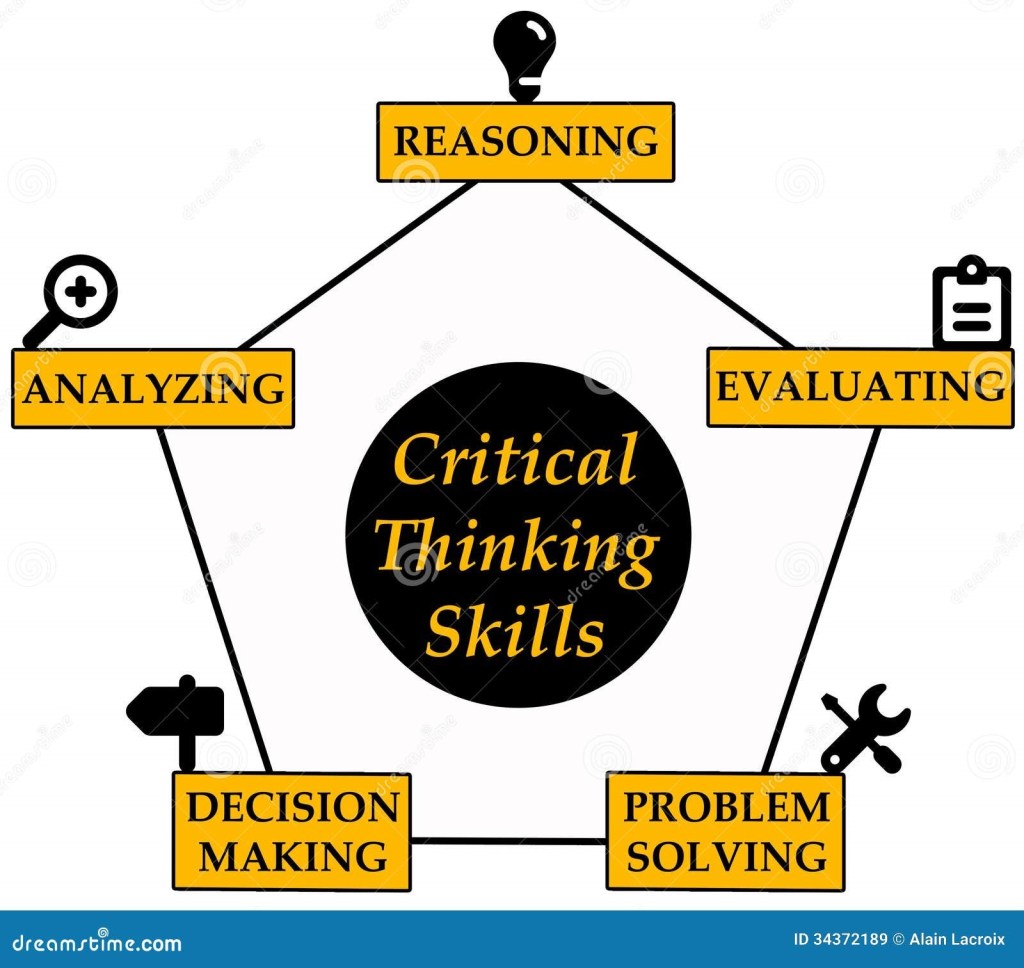
- Reasoning:
Start with the problem, or assignment: Articulate the problem, or define the objective.
What other ways can we state the problem or objective?
Establish Context: Who “owns” the problem? Why are we doing this/Why was it requested? What is the background to this assignment or project?
What has been done in the past? Has anything similar been done? What worked or didn’t work.
What is the business or consumer environment or other influences on this situation?
State any assumptions: What do we know? What don’t we know? What do we need to find out? What is it safe to assume? - Analyzing:
Brainstorm a list of possible resources, things (people, information) that might help you learn more, provide context or ideas.
Gather information or inspiration to help you brainstorm.
Keep an open mind; question how things have been done in the past and why things have worked or not worked Brainstorm a list of possible approaches. (Brainstorming is always better with another good brainstormer. Start out with, “What if…”) - Evaluating
What constraints do we have, e.g. time, money, biases? Which characteristics of your possible solutions should be prioritized?
Organize your ideas and consider the pros and cons of each.
Bounce your ideas off others; consider additions or revisions.
What are some ways to overcome some concerns about some of the ideas?
Walk away for a while and revisit your ideas and inspiration with fresh eyes. - Decision Making
Organize your recommendations so that you can present them logically. Start with context to remind everyone of the assignment/objective.
Include support points and your reasoning. Why are you recommending it? What makes it stronger than other solutions?
What are some potential weaknesses to watch out for, and how might they be addressed.
Maybe once you know how to approach this awkward feeling of “I’m not exactly sure what I’m supposed to be doing”, then you might actually kind of start to lean in to this kind of situation because it’s kind of an exciting challenge.

Like a mystery to solve, or a puzzle to figure out.
And an opportunity to demonstrate and STRENGTHEN your ability.
Speaking of which, be open: Ask for feedback, input, suggestions from colleagues or mentors to strengthen your approach along the way, and as you share your solutions.
Before you know it, you might even EMBRACE ambiguity the next time it comes along!

 All Posts (Home)
Leave a comment